Blog Post
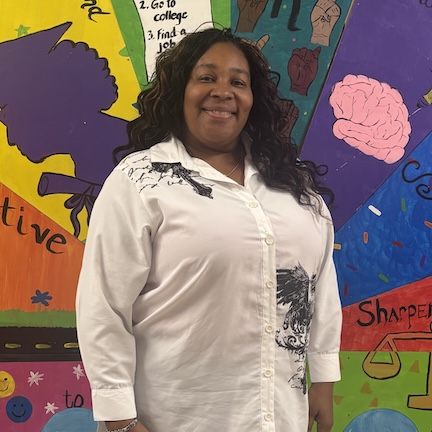
On the Path from Paraprofessional to Teacher: How Angela Austin Is Pursuing Her Dream Without Putting Work on Pause
After years of trying to balance college with work and other responsibilities, paraprofessional Angela Austin found a job-embedded route to becoming a certified teacher.
Angela Austin has spent nearly a decade helping students as a paraprofessional. But her path to the classroom has not been a straight one.
After working in education for several years, Angela left the school system to explore a career in insurance. Although she was successful, something was missing.
“I didn’t feel like I was making a difference like I did when I was working with kids,” Angela said. “I realized that was actually my passion. I love to teach.”
That realization eventually brought her back to Bibb County School District in Macon, Georgia, where she now works as a special needs paraeducator—and is pursuing her dream of becoming a certified teacher through a job-embedded degree pathway supported by BloomBoard.
The desire was there. The traditional pathway wasn’t working.
Angela had already earned an associate degree and had tried several times to return to college. But like many working adults, she found it difficult to balance classes with a full-time job, bills, and the cost of tuition.
“Being an adult, trying to work and pay bills and do all these different things—it just got to be too much,” she said. “Paying out of pocket for everything got to be a lot.”
The challenge wasn’t a lack of ambition or commitment. Angela needed a pathway that could fit into the life she was already living.
When Bibb County shared an opportunity for paraprofessionals to earn their degrees while continuing to work, she decided to apply. More than 100 people expressed interest, and Angela was one of five employees selected for the initial cohort.
“When this program came along, it was like, ‘You can still work and get your degree because you’re getting your coursework done on the job,’” Angela said. “You can’t really beat that.”
>Video clip: A pathway that finally fit her life
Learning and applying new skills at the same time
The program’s job-embedded structure allows Angela to connect what she is learning directly to her work with students.
Rather than completing coursework first and waiting until the end of the program to gain classroom experience, she can immediately put new strategies into practice.
“As soon as you’re learning it—or while you’re learning it—you’re applying it,” Angela explained. “I get to hear this, see this, and then actually go and apply it.”
The model also enables her to complete her classroom experience without stepping away from her job or sacrificing her income.
“I’m doing student teaching now while I’m doing the learning part,” she said. “And I’m getting paid to do so because I’m doing the job I was already doing. I’m still paying my bills, but I’m also doing the coursework and the different things I need to do to obtain the degree.”
>Video Clip: Learning, teaching, and earning at the same time
Understanding the “why” behind instruction
Angela entered the program with years of valuable classroom experience. As a paraprofessional, she understood classroom routines, student needs, and classroom management.
The program is now helping her build the deeper instructional knowledge she will need as a certified teacher.
“As a paraprofessional, we know how the classroom runs, but the lesson-planning piece—how the lessons come about, how to scaffold and how to break down small groups—those were things I didn’t know.”
Learning the theory behind the practices she had observed for years has given Angela a new perspective on instruction. She is no longer simply watching a teacher use a strategy; she understands why it is being used and can begin applying it herself.
“It’s opening up a lot of the ‘Why do we do that?’” she said. “Now I understand.”
That growth is already changing Angela’s role within her school. She is gaining opportunities to teach, participate in instructional planning and communicate more regularly with families.
“I’m not just in a classroom assisting, I’m having the opportunity to actually teach.”
>Video clip: From supporting instruction to understanding it
Support from every direction
Angela is not navigating the journey alone. She receives support from her school, Bibb County School District and her university.
Her school-based mentor—an instructional coach—provides hands-on guidance when Angela needs help. She also values learning from faculty members who understand the realities of today’s classrooms.
“My professor last semester was a third-grade teacher, so she’s in the trenches,” Angela said. “It’s not someone who hasn’t taught in a hundred years.”
That combination of practical coursework and responsive support has helped make a challenging goal feel achievable.
“You have support not only from your school, but also from the district,” Angela said. “And the support from the college has been amazing.”
>Video clip: An amazing support system
A dream—and the beginning of something bigger
For Angela, earning her degree and becoming a certified teacher represents the fulfillment of a goal that has taken years to reach.
“Teaching is a passion of mine. I come from a long line of educators,” she said. “It is fun to be able to see my goal and this dream finally come full circle. It took a while. I went a lot of different ways, but it really took a while.”
Becoming a teacher is not the end of Angela’s professional journey. She hopes to eventually move into school administration, making certification an important first step toward a much larger goal.
For other paraprofessionals who may be wondering whether they can balance work, college and life, Angela’s message is simple:
“Go for it.”
“You’re not having to put everything on pause,” she said. “You’re getting an opportunity to learn and do while you’re in school.”
> Video Clip: Angela’s advice to other paraprofessionals
Angela’s story shows what becomes possible when districts invest in the talented people already serving their students. With an accessible pathway, practical support and the ability to keep working, experienced school employees can take the next step toward becoming the teachers their communities need.
Your next great teacher may already be working in your district. To speak with BloomBoard about how we can help your district build job-embedded pathways for school employees, email hello@bloomboard.com.
Recent Posts
Investing in Your Own People Pays Off: Pennsbury's First Grow Your Own Graduates
August 27, 2026

Doane University and BloomBoard Partner to Expand On-the-Job Degree Pathways for Educators
June 16, 2026